A Historic Step for Wildlife and Human Health: DRC Suspends Primate Exports
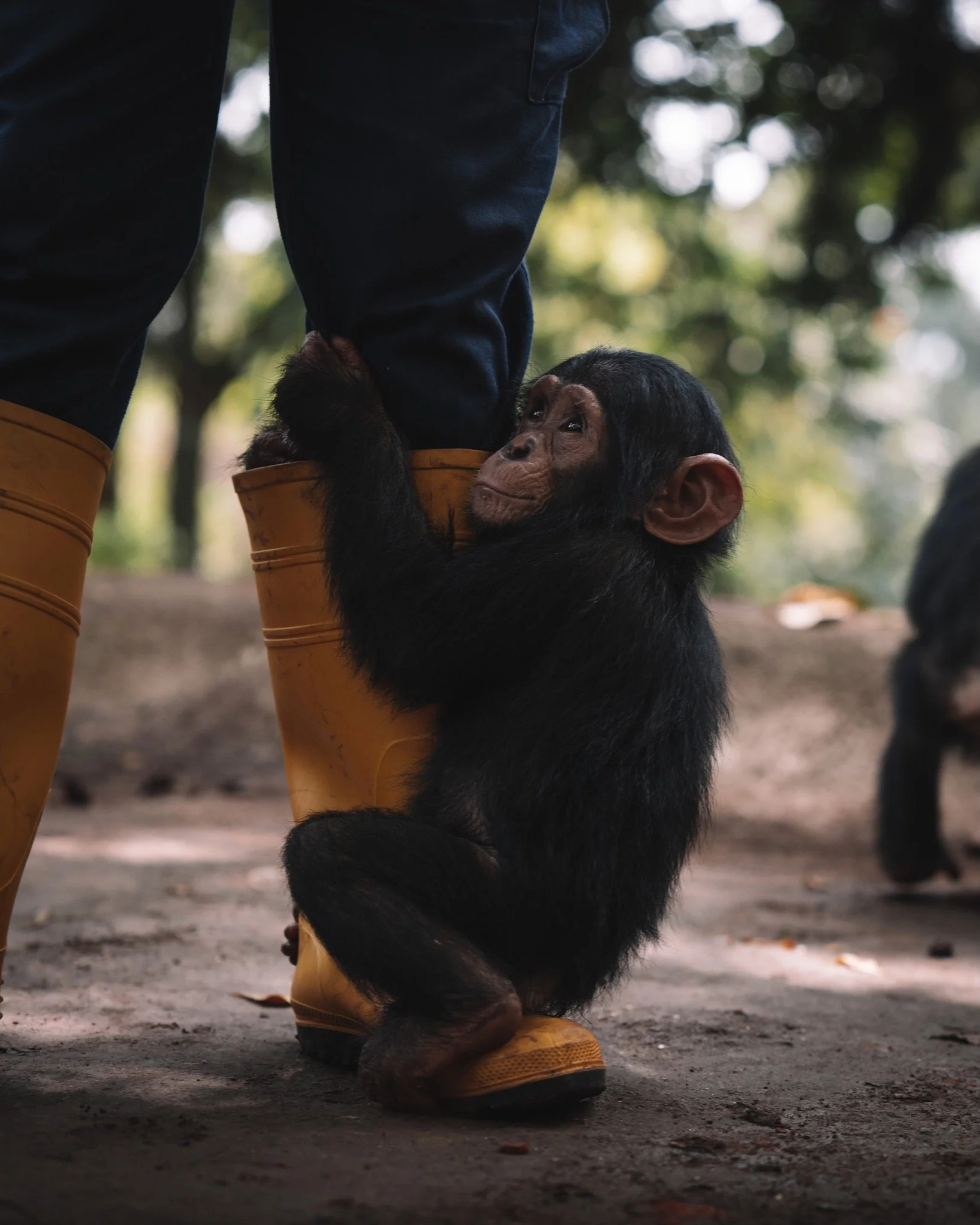
An infant chimpanzee clings to a caregiver at LPRC.
Something just happened that has never happened before in the Democratic Republic of Congo — and it matters for both wildlife and people around the world.
The DRC's Institut Congolais pour la Conservation de la Nature (ICCN), the government body responsible for wildlife, has temporarily suspended all export permits for non-human primates. In plain terms: no monkeys or apes can legally leave the country while this order is in effect.
For those of us working to protect primates in the DRC, this is significant news.
Why now?
The DRC is in the middle of its 17th Ebola virus disease epidemic, declared in May 2026 and classified by the World Health Organization as a Public Health Emergency of International Concern. Ebola is a deadly hemorrhagic fever that can cross from animals to humans. Non-human primates, including monkeys and chimpanzees, are highly susceptible to the virus, often with devastating mortality rates.
Here is where wildlife trade becomes a public health problem. When primates are captured from the wild, transported long distances, and handled by people along the way, they can carry and transmit viruses across borders. An infected animal caught in an Ebola-affected forest in the DRC and shipped to another continent does not leave the virus behind.
The suspension order cites the need "to prevent any significant increase in the probability of crossing the species barrier … and the amplification of community transmission chains[.]" That is government language for a straightforward idea: moving primates during an outbreak is dangerous.
What is "One Health" — and why does it matter here?
The suspension is grounded in a framework called One Health. The concept is simple but powerful: the health of humans, animals, and ecosystems are not separate: they are deeply connected. A disease that spreads in a forest can end up in a city. Wildlife that is stressed, captured, or transported across the world can become a vector for pathogens that neither the animals nor the people handling them can afford to encounter.
One Health asks governments, scientists, and conservation organizations to work together across those traditional boundaries. In this case, the DRC National Ebola Task Force asked the country's wildlife management authority — ICCN — what it could do to contribute to Ebola prevention. The answer was: stop primate exports.
It is a practical, science-based decision. And it is the kind of decision that One Health thinking makes possible.
More than one reason for the suspension
The Ebola epidemic was the trigger, but it was not the only factor. Several other developments appear to have contributed.
Between 2023 and 2025, the DRC exported thousands of monkeys to a private facility in India called Vantara, through a single commercial wildlife trader. Those transactions drew international scrutiny and raised questions about the transparency and legality of the trade.
In July 2026, the 34th meeting of the CITES Animals Committee, the international body that oversees trade in endangered species, made recommendations specifically about the DRC's primate trade. CITES is the global treaty that regulates wildlife commerce, and when its committees flag a country's trade, that carries diplomatic weight.
In addition to government officials, the suspension order is explicitly addressed to LINEFCO, a Congolese wildlife trade organization with a decades-long record of involvement in wildlife trade, including shipping thousands of monkeys to Vantara.
The official language of the order frames it not only as a health measure but as an opportunity for the DRC to "restore its diplomatic image and reputation" as a country of extraordinary biodiversity and a critical player in global forest preservation.
What this means at Lwiro
At the Lwiro Primate Rehabilitation Center (LPRC), the largest chimpanzee rehabilitation center in DRC and the only one of its kind in eastern DRC, this decision resonates deeply.
Many of the chimpanzees and monkeys in our care were confiscated from traffickers or rescued from the illegal pet trade. Their stories are a direct consequence of the commercial wildlife market this order, at least temporarily, interrupts.
We are also no strangers to the Ebola threat. When the 17th epidemic was declared, we immediately reinforced prevention and containment protocols to protect our 227 rescued primates and the more than 60 Congolese staff who care for them. The intersection of wildlife conservation and public health is not abstract to us — it is our daily reality.
Reasons for cautious hope
History gives reason for skepticism. Wildlife trafficking syndicates are well-resourced, well-connected, and experienced at exploiting gaps in enforcement. A suspension order is only as strong as the system that implements it.
But this order is real. The legal basis is documented. Names are on paper. And the international community — scientists, conservation organizations, public health officials, law enforcement — now has a clear opening to support DRC in holding the line.
We know which side we are rooting for.
If you have connections in DRC, or in global transportation, finance, public health, or law enforcement, please share this news. Implementation requires all hands on deck.
Lwiro Primate Fund supports the Lwiro Primate Rehabilitation Center in the Democratic Republic of Congo, where a team of over 60 Congolese staff cares for 227 rescued primates. Learn more about the sanctuary.